
6 AI Summary Modes Explained: ELI5 vs ELI10, Key Points and More
TL;DR: PageSum has 6 summary modes — Quick, Detailed, Key Points, ELI5, ELI10, and One-Liner. Quick is for triage, Detailed for deep understanding, Key Points for notes, ELI5/ELI10 for simplifying jargon, and One-Liner for recall. Start with Key Points if you're unsure.
Most people do not need "an AI summary." They need the right kind of summary for the task in front of them. A short overview is great for triage and weak for study. A detailed breakdown is useful for research and excessive when you only want the gist.
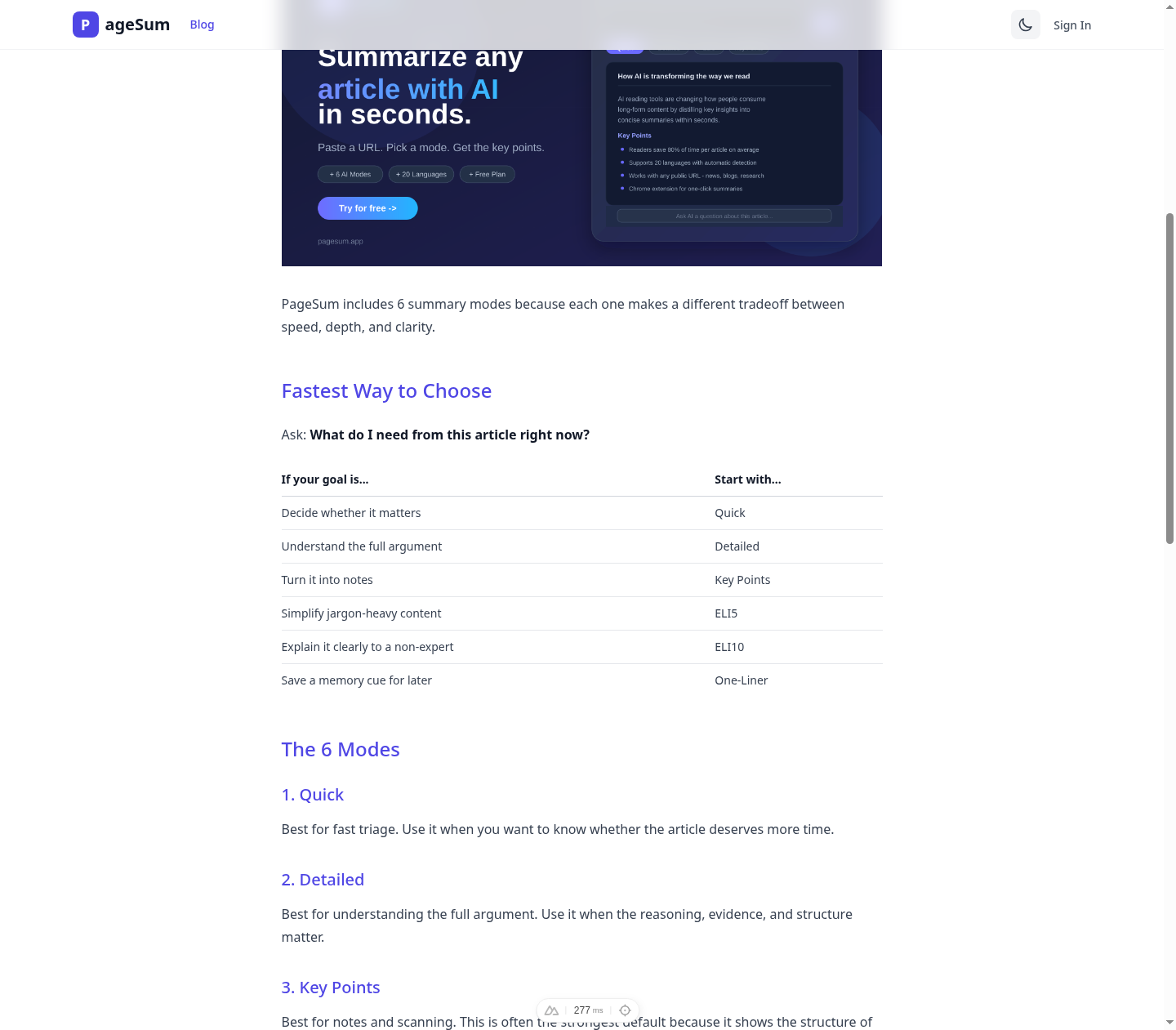
PageSum includes 6 summary modes because each one makes a different tradeoff between speed, depth, and clarity.
Fastest Way to Choose
Ask: What do I need from this article right now?
| If your goal is... | Start with... |
|---|---|
| Decide whether it matters | Quick |
| Understand the full argument | Detailed |
| Turn it into notes | Key Points |
| Simplify jargon-heavy content | ELI5 |
| Explain it clearly to a non-expert | ELI10 |
| Save a memory cue for later | One-Liner |
The 6 Modes
1. Quick
Best for fast triage. Use it when you want to know whether the article deserves more time.
2. Detailed
Best for understanding the full argument. Use it when the reasoning, evidence, and structure matter.
3. Key Points
Best for notes and scanning. This is often the strongest default because it shows the structure of the article quickly.
4. ELI5
Best for unfamiliar or technical topics. It simplifies aggressively, which makes it useful for orientation but weaker for precision.
5. ELI10
Best for clear, readable explanations with more nuance than ELI5. Good for smart non-experts and cross-functional teams.
6. One-Liner
Best for labeling and recall. It is not complete; it is a memory cue.
ELI5 vs ELI10: What's the Difference?
ELI5 means "explain like I'm 5" and ELI10 means "explain like I'm 10". Both rewrite a text in plain language. The difference is how much they keep:
| ELI5 | ELI10 | |
|---|---|---|
| Vocabulary | Everyday words, no jargon | Plain words, with 1–2 key terms kept and highlighted |
| Structure | 1–2 short paragraphs built on simple comparisons | 2 paragraphs: what happened and why, then why it matters |
| Best for | A first look at a topic you know nothing about | Understanding a topic well enough to explain it to someone |
| Risk | Oversimplifies; loses precision | Still a simplification, not a substitute for the original |
Pick ELI5 when you just need to know what something is about. Pick ELI10 when you also need to know why it matters, for example a news story, a policy change or a technical explainer you have to act on.
One Article, Different Outputs
Imagine a long article about a new workplace AI law:
- Quick gives the main claim.
- Detailed keeps the logic and tradeoffs.
- Key Points turns it into working notes.
- ELI5 strips out legal jargon.
- ELI10 keeps clarity with more nuance.
- One-Liner gives you one sentence to remember it later.
That is why the right mode is not about article length alone. It is about your reading goal.
Common Mistakes
- Using Detailed when you only need triage
- Using ELI5 when exact wording matters
- Assuming shorter is always better
- Expecting one mode to fit every article
Simple Recommendation
If you are unsure where to start:
- Use Key Points first.
- Switch to Detailed if the article looks important.
- Use ELI5 or ELI10 if the topic is denser than expected.
- Save a One-Liner if you want to remember the article later.
If you want to compare the modes on your own reading workflow, PageSum lets you run the same article through all six and see which output is actually useful.
To see these modes in action on a real workflow, read How to Summarize Any Article Online in Seconds or How to Summarize a PDF for Free. You can also access all six modes directly from the PageSum Chrome extension. All 6 modes also work on video files — see How to Summarize Video Files with AI.
Try it on your video
Paste a TikTok, Instagram Reel, Facebook, X or YouTube link and get the transcript and a summary in seconds. Free, no credit card.
More posts
How to Summarize Any Article Online in Seconds
Learn how to summarize articles online with AI, choose the right summary style, and know when to trust the summary versus reading the full piece.
How to Summarize a PDF for Free (Without Copy-Pasting)
Summarize any PDF online for free. Drag, drop, and get an instant AI summary — no copy-pasting required. Works with research papers, reports, and ebooks.
Transcript API vs Summary API: Which One Does Your App Need? (2026)
A transcript API returns the words; a summary API returns the finished summary. How they differ, what each costs per video, what happens when a video has no captions, and Python and JavaScript examples.
How to Turn a DIY or Gardening Reel Into a Step-by-Step Checklist
Paste a how-to Reel, TikTok or Facebook video into PageSum and get numbered steps with a materials list first, plus the summary and transcript. Works for gardening, home remedies, crafts, repairs and software setups, even without captions.
How to Save Instagram Reels as Notes (Apple Notes, Notion, Obsidian)
Instagram's Saved folder is where good Reels go to be forgotten. Paste a Reel link into PageSum to turn what the creator says into a short written note plus the full transcript, then keep it in Apple Notes, Notion or Obsidian. Works without captions; one Reel a day free.
How to Turn StudyTok Videos Into Notes and Flashcards
Study TikToks and YouTube Shorts explain a concept in 60 seconds, then disappear into your feed. Paste the link into PageSum to get written notes and the transcript, and on Pro turn them into flashcards and quizzes with a spaced-repetition review. Steps, limits and what's free.